OPENING / FROM THE FIELD
I remember stepping out of the car on the first morning and just stopping.
Not because something dramatic was happening. Not because there was a shot presenting itself or a moment demanding to be captured. I stopped because for the first time in a long time nothing was being asked of me. No crew. No client. No brief on my phone. No production schedule in my pocket. Just a street in Havana waking up in the early morning light and me standing in the middle of it with a small camera and nowhere particular to be.
I cannot tell you the last time I felt that. The stillness of having nothing to deliver.
I just stood there and breathed it in.
TECHNICAL NOTEBOOK
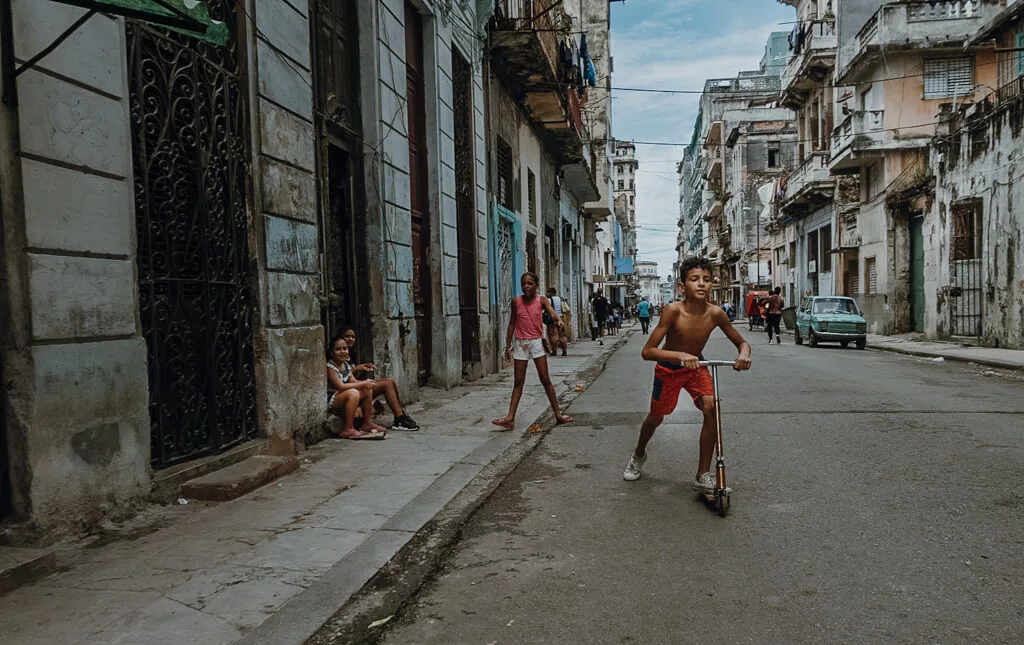
These are the actual decisions I made in the first hours. Not theory. Not what the manual says. What I did, why I did it, and what happened.
The light at 7am in Havana is extraordinary. Low, warm and directional. Raking across building facades and pulling every texture into sharp relief. I knew it would not last. By 9am the sun would be high and the quality of light that was making everything look like a painting would be gone. So the first decision was ISO.
I settled on ISO 400. Clean, controlled and with enough sensitivity to work comfortably in the early morning available light without introducing unnecessary grain. The Sony RX1R handles ISO 400 beautifully. The files are tight and detailed and hold up exceptionally well in Adobe Lightroom post processing when you push the shadows or pull the highlights back.
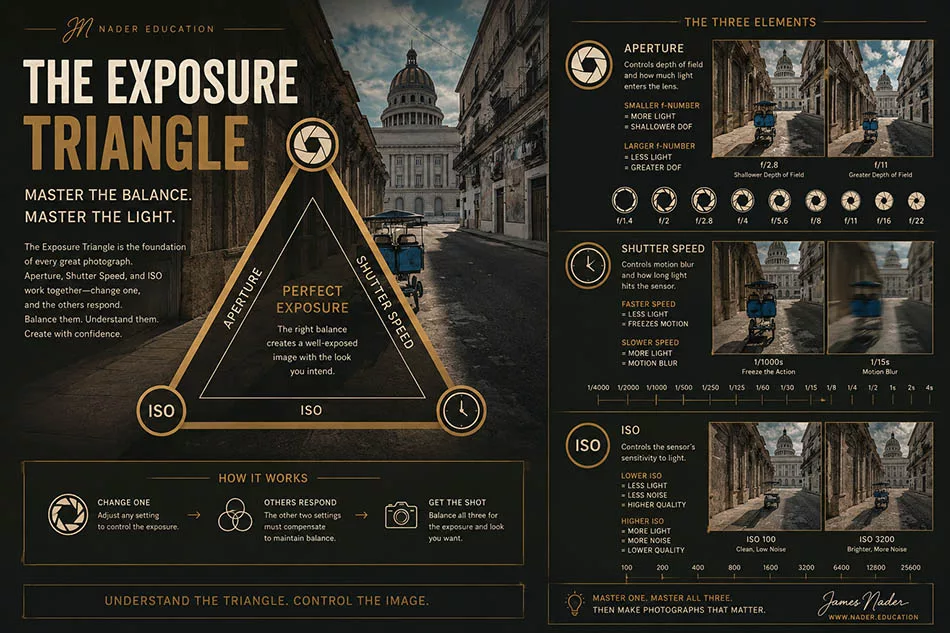
The exposure triangle on the street in Havana:
ISO 400. Clean and controlled, with enough sensitivity for available light street photography without sacrificing full frame file quality.
Aperture f5.6. Sharp across the frame, with enough depth of field to keep the subject and their immediate environment in focus whilst allowing the background to fall away naturally.
Shutter speed 1/500 to 1/1000. Fast enough to freeze street movement and fast enough to shoot instinctively without camera shake in bright tropical light.
The reasoning behind f5.6 specifically is this. On a street you are rarely working at a fixed distance. Someone steps into your frame, a moment presents itself and you have a second to react. At f2 or f2.8 the margin for error on focus is almost nothing. At f5.6 you have enough depth of field to make the shot even if your focus point is slightly off. You keep the subject sharp, you keep enough of the environment to give the image context and the background still separates naturally.
It is not the most dramatic aperture setting. It is the most reliable one for street photography. And on a street in Havana reliability is what gets you the shot.
The Sony RX1R has no zoom. The fixed 35mm Zeiss lens means every composition decision is made with your feet. You want a tighter frame so you walk forward. You want context so you step back. There is no halfway. That discipline changes how you see and how you approach street photography composition. After an hour with a fixed lens on a street like this you stop thinking about focal length entirely and start thinking only about distance and relationship. How close do I need to be to this person to make this picture true.
Street photography composition in Havana:
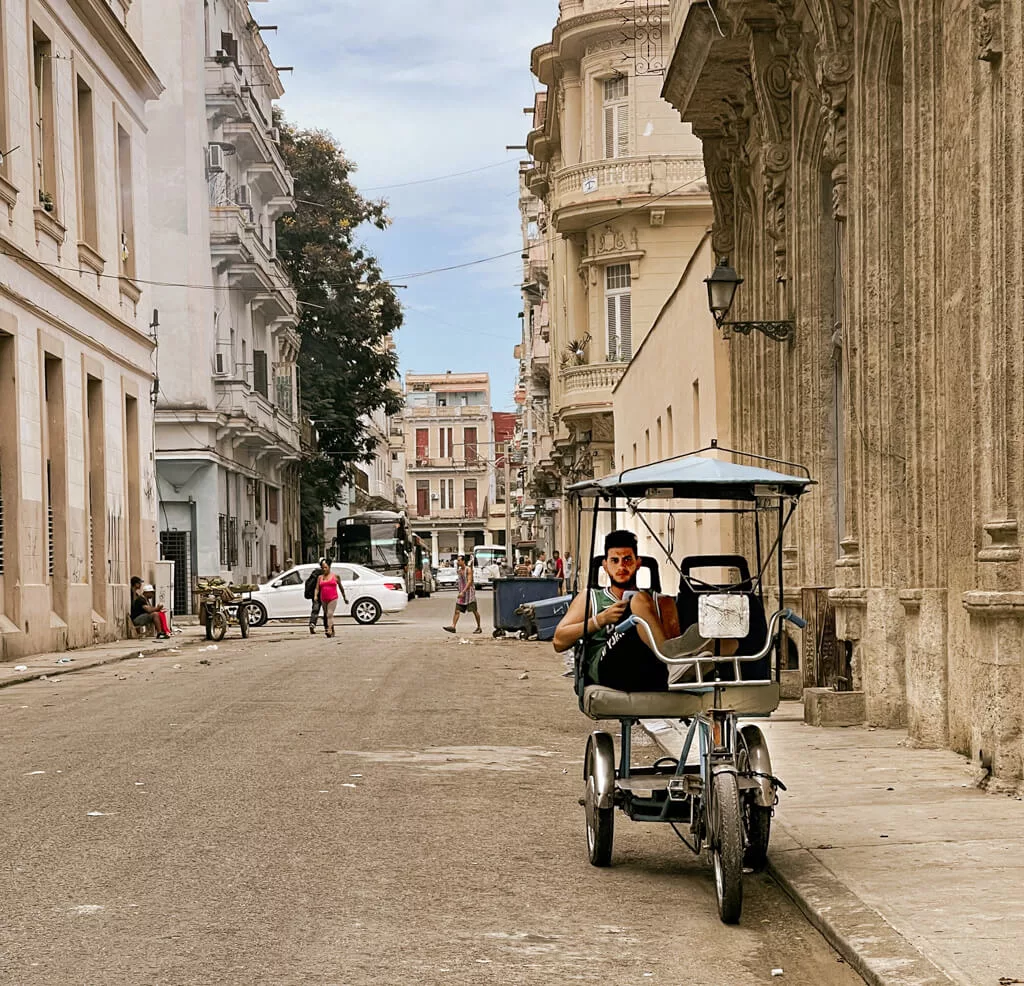
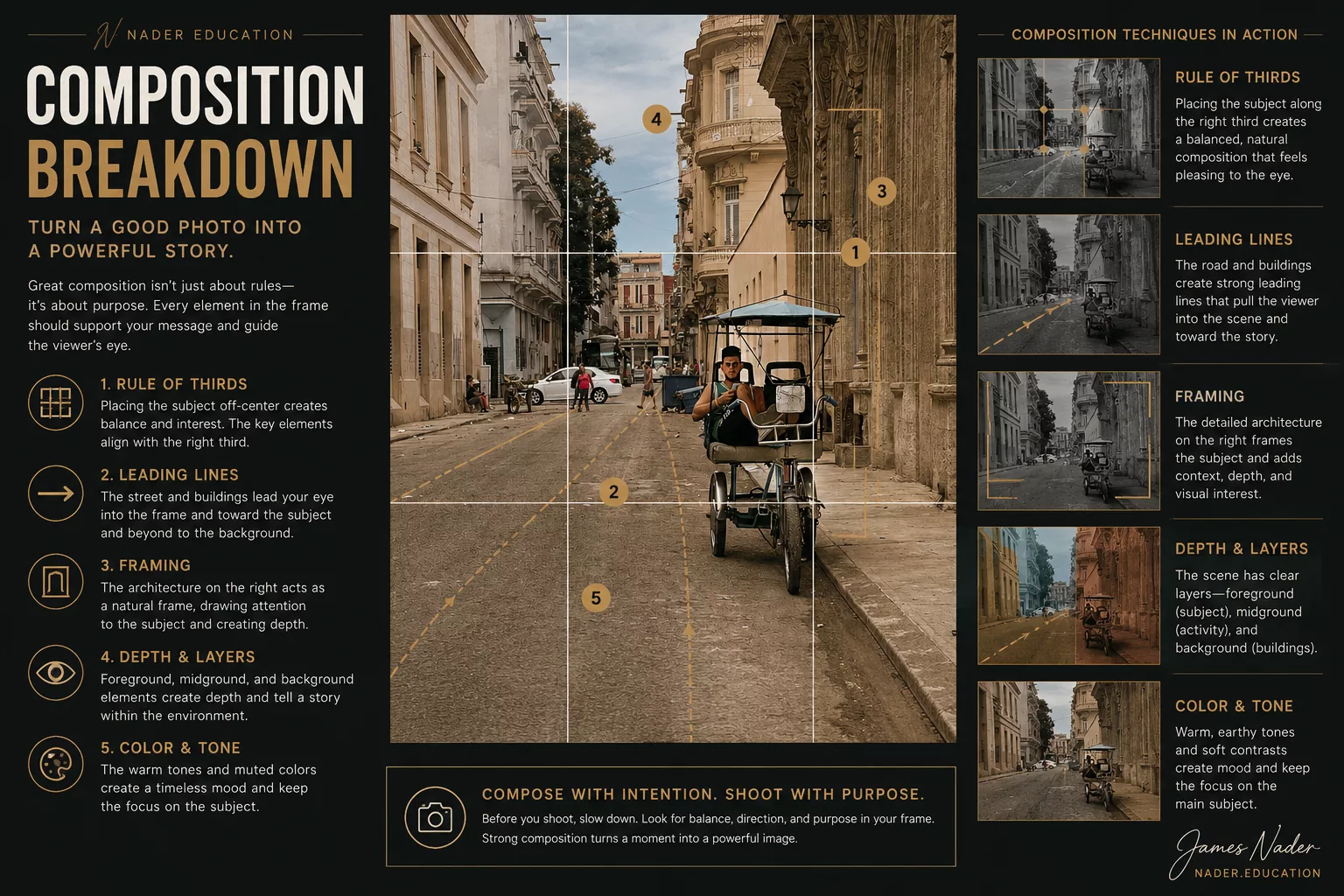
The city gives you natural frames everywhere. Archways. Doorways. The gap between two buildings where the light comes through. I was constantly looking for layers. Something in the foreground, something in the middle distance and something beyond. The depth of Havana’s streets lends itself to this naturally. A classic car in the foreground, a musician at mid distance and a faded wall behind. Three planes, one frame, one moment.
The other thing Havana taught me about street photography composition was to stop centring everything. The instinct when something catches your eye is to put it in the middle of the frame. The better instinct, the one that takes longer to develop, is to let it sit where it actually is. Off to one side. Partially obscured. Half in shadow. Let the frame breathe around the subject.
Getting the exposure right in tropical light:
The single most important decision I made every hour in Havana was which direction to face.
In harsh tropical light the difference between a beautiful photograph and an unusable one is whether the sun is behind you, beside you or in front of you. I learnt quickly to spend the middle of the day shooting into shade. Finding streets where the buildings created natural shadow, looking for doorways and arcades and covered markets where the light was bounced and softened rather than direct and overwhelming.
The magic hours, the first hour after sunrise and the last hour before sunset, I gave entirely to the streets. No food. No coffee. Just the camera and the light whilst it lasted.
THE CITY
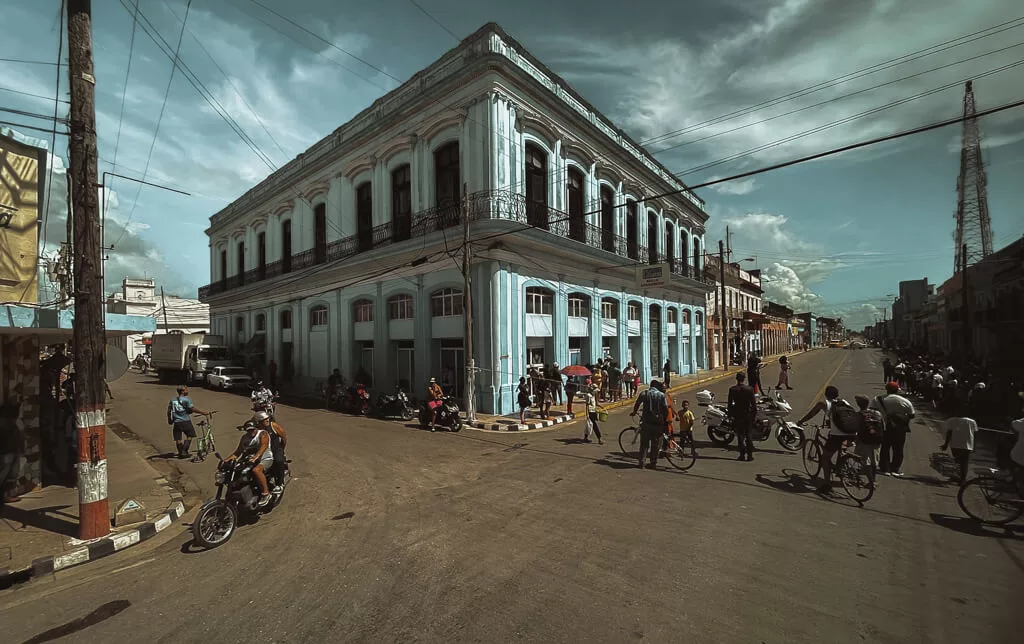
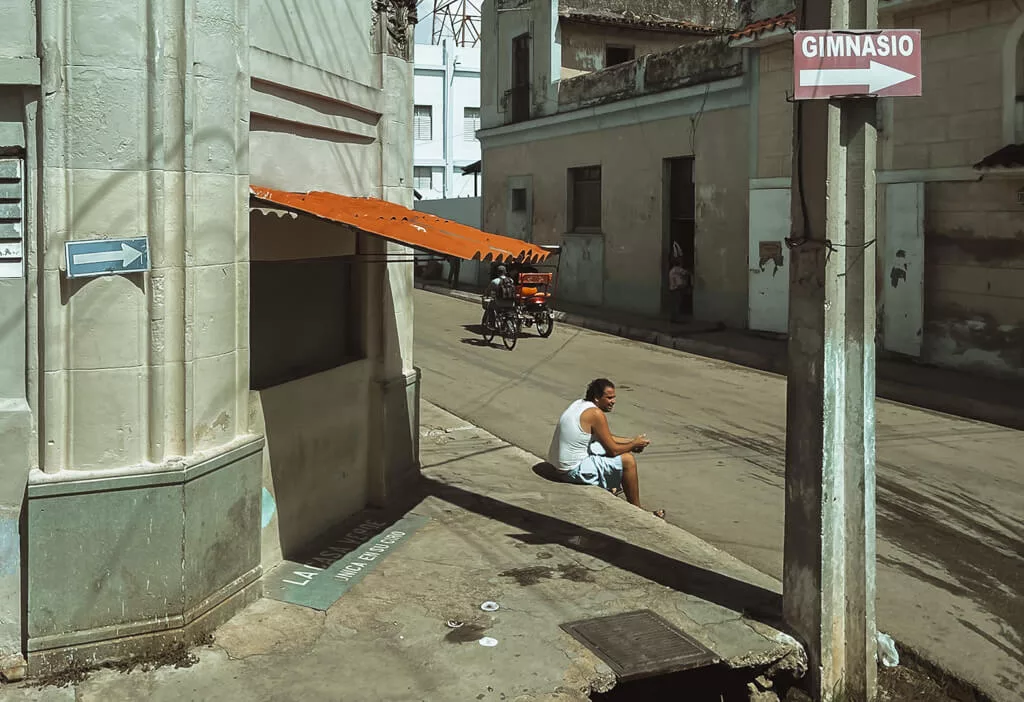
Havana does not ease you in. It arrives all at once.
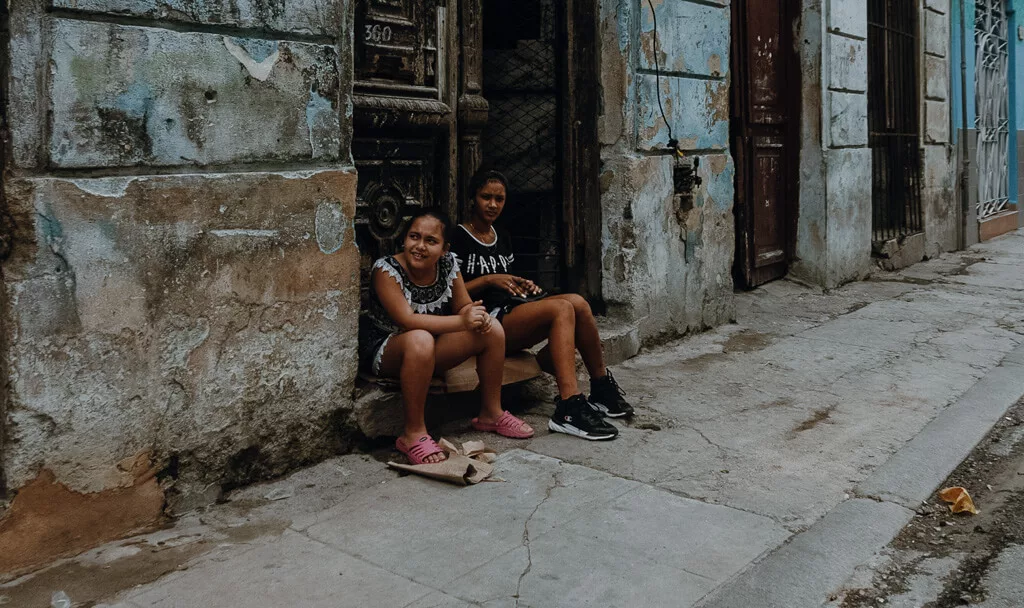
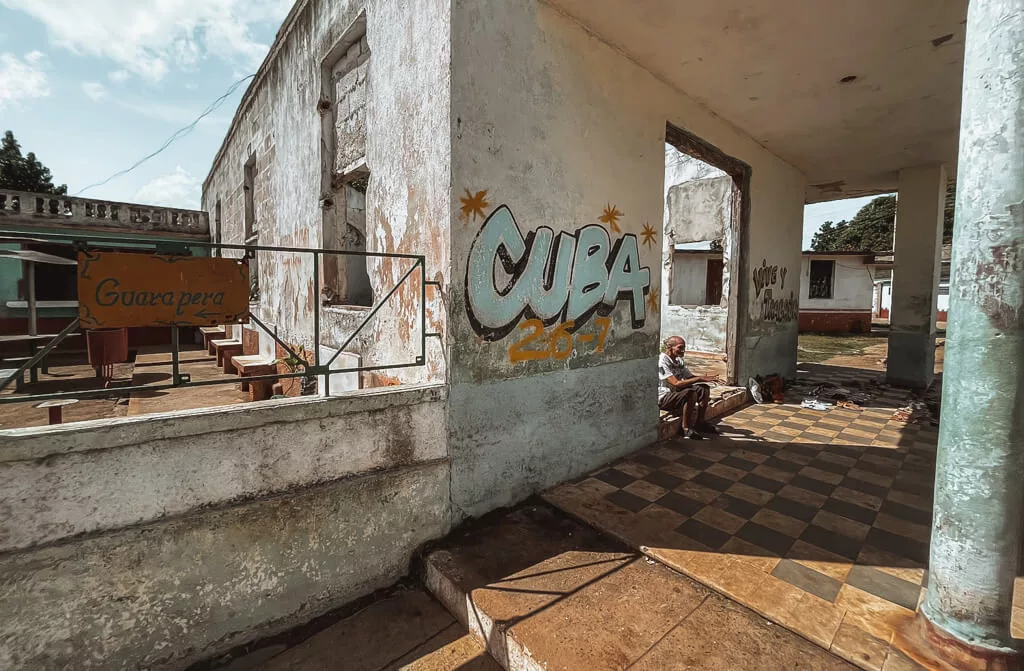
The colours are the first thing. Not the postcard colours you have seen a hundred times but something rawer and more complicated than that. Yellows that have been bleached by decades of tropical sun. Blues that have faded into something softer and sadder and more beautiful than they were when they were new. Pinks and greens peeling away from walls that have been standing since before anyone alive can remember. Havana is in a constant state of beautiful decay and once you stop trying to fix it in your frame and just let it be what it is, it becomes one of the most visually extraordinary locations I have ever pointed a camera at.
Then the sound arrives. Music from somewhere you cannot quite locate. A radio in a window. Someone playing in a courtyard two streets away. The rhythm of it is underneath everything in Havana. Not loud, not performed for tourists, just present. The way music is present in a city that has lived with it for generations.
And then the heat. Dense and close and immediate. The kind of heat that slows everything down including you. Which, I realised after the first hour of street photography in Havana, was exactly what I needed.
THE CAMERA
I made a deliberate decision before I left for Havana not to bring the commercial kit.
No strobes. No assistants. No full frame mirrorless system with a bag full of lenses. I wanted to travel light in every sense. Not just physically but mentally. I wanted to remove the full apparatus of professional photography and see what happened when I was just a person with a small camera walking through a city.
The Sony RX1R was the right choice for exactly that reason.
It is a remarkable piece of camera engineering. A full frame 35mm sensor in a body small enough to sit in your jacket pocket. The fixed 35mm f2 Zeiss lens is one of the sharpest lenses I have ever used. Corner to corner, wide open or stopped down, it renders with a clarity and a character that is completely distinctive. The Sony RX1R is not a camera that announces itself. It sits quietly in your hand and gets out of the way.
On a commercial shoot I am always making decisions about camera equipment. On this trip the equipment made no demands on me at all. The RX1R disappears in your hand. Nobody looks at it twice. In a city where people are relaxed and open and unbothered by cameras, a small quiet camera is an invitation rather than an intrusion. It changed the entire dynamic of how I worked.
I shot everything on available light. No flash. No fill. No artificial light source of any kind. Just whatever Havana was giving me that day and the decisions I made about how to use it.
THE LIGHT
The tropical light in Havana is brutal and beautiful in equal measure.
By mid morning the sun is already high and the shadows are hard and the contrast is extreme. On a commercial fashion photography shoot that would be a problem to solve. Flags and diffusion and waiting for the light to change or the clouds to move. In Havana I had none of those things and no desire for them.
I learnt to work with the available light instead.
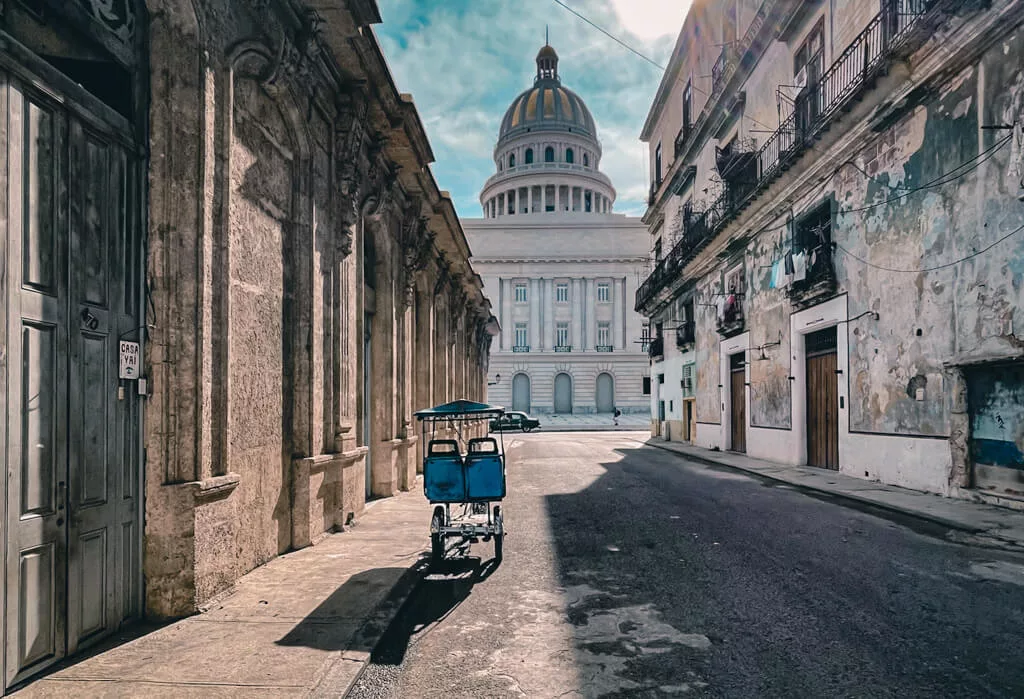
The harsh shadows became part of the street photography composition. The way a stripe of sunlight fell across a doorway and left everything beyond it in deep shade. That contrast was the photograph. The way a woman’s face was half lit and half lost in shadow as she stood in the entrance to a building. That was not a lighting problem to fix. That was the shot.
In the early mornings and the late afternoons the Havana light changed completely. Low and warm and raking across the facades of the buildings, pulling every texture and imperfection into relief. The peeling paint. The weathered stone. The rust on a vintage American car parked against a pastel wall. In that available light every surface in Havana becomes a photograph.
I started waking earlier just to be in it.
FEELING AND SAFETY
I want to be honest about something I did not expect from this trip.
I felt completely safe in Havana.
I had heard the usual things before I left. The warnings that follow any destination that sits outside the familiar. But the reality of being there was something entirely different. Walking through the streets of Havana Vieja alone with a camera, stopping to photograph whoever and whatever caught my eye, I never once felt watched or threatened or unwelcome.
The opposite was true.
There is a quality to life in Havana that I have not encountered anywhere else in thirty years of international travel and location photography. A slowness. A genuine presence. People are actually where they are. Not half somewhere else on a phone, not rushing between obligations. They are sitting in doorways watching the street. They are talking to each other. They are playing music because the music needs to be played, not because anyone is paying attention.
That quality, that authentic human presence, is what I had come to find. And it was everywhere I looked.
NVOS
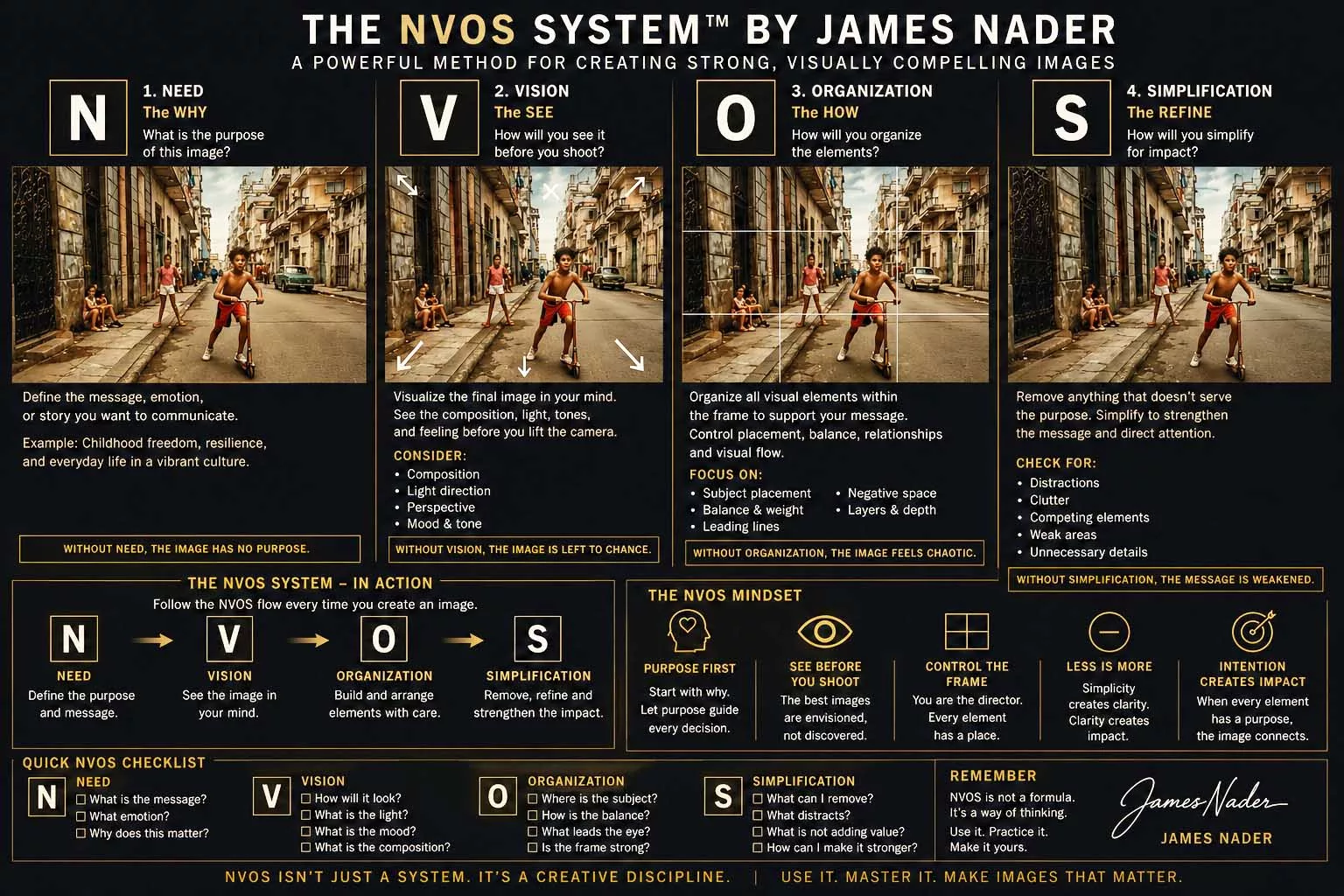
I developed the NVOS system across decades of high pressure commercial photography work. It is a framework for maintaining creative vision and professional composure when the stakes are at their highest. When the budget is large, the celebrity client is in front of your lens and the crew is waiting for you to make the call.
But Havana showed me something I had not fully understood about NVOS until I was standing alone on a street with a small camera and no brief.
The system is not just for pressure. It is for presence.
NVOS works on an eighty thousand pound celebrity photography shoot because it keeps you grounded when everything outside is pulling at your attention. But it works just as powerfully on a quiet street in Havana because it keeps you seeing when there is nothing forcing you to look. It is the difference between walking through a city as a tourist and walking through it as a photographer. Between passing a moment and being inside it.
The NVOS system teaches you to arrive at any situation, whether that is a high pressure commercial fashion photography shoot or a personal street photography project in Havana, with your eye already open and your creative instincts already running. Not waiting for the shot to announce itself. Already in the frame before the frame exists.
That is what separates photographers who build a body of work that lasts from those who only perform well when someone else is directing them.
Whether you are shooting a high budget advertising production or walking the streets of Havana alone with a pocket camera, the system is the same. The presence is the same. The seeing is the same.
If you want to understand how the NVOS system works and how to apply it to your own photography, whatever level you are at and whatever you are shooting, everything is at jamesnadereducation.com
WHAT THIS TRIP GAVE BACK
I came back from Havana with images that will never appear in a client campaign. They are too quiet. Too slow. Too personal.
But they gave me something back that years of commercial photography had slowly taken. The feeling of being inside a photograph rather than building one. The experience of not knowing what was coming next. The patience of waiting for a moment rather than constructing one.
The eye you develop on personal photography projects is the eye you bring to everything else. The patience you build shooting street photography in Havana is the same patience that keeps you sharp when a commercial production is not going the way it should and the pressure is building and you need to find the shot anyway.
Personal photography projects are not a break from professional work. They are what keeps the work honest.
This is the first in a series of Field Notes from my personal projects. The shoots I do for no one but myself. The places I go to find something real without a brief, without a crew and without anything being asked of me except that I pay attention.
Havana was where it started again.
FAQ
What camera did James Nader use in Havana?
The Sony RX1R. A full frame compact camera with a fixed 35mm Zeiss f2 lens. Small, unobtrusive and exceptionally sharp. The ideal camera for available light street photography where you need full frame image quality without the presence of a large professional camera system.
What are the best camera settings for street photography in bright tropical light?
ISO 400 for clean file quality. Aperture f5.6 for reliable depth of field and sharp results across a range of distances. Shutter speed between 1/500 and 1/1000 to freeze movement and shoot instinctively. These were the actual settings used throughout this Havana street photography project.
What is the NVOS system?
The NVOS system is a framework developed by James Nader across thirty years of commercial fashion photography. It is a system for maintaining creative vision and professional composure under pressure. It is applicable equally to high budget advertising productions and personal street photography projects. Full details and courses are available at jamesnadereducation.com
Is Havana safe for photographers?
In James Nader’s experience shooting street photography alone in Havana Vieja and across the city, Havana was welcoming, relaxed and safe throughout. The local people were open and genuine, the atmosphere was unhurried and shooting candidly on the street felt natural and comfortable at all times.
How do you get good street photography results in harsh sunlight?
Work the direction of light rather than fighting it. Shoot in shade during the harsh midday hours. Look for streets with natural shadow, covered arcades and doorways where light bounces rather than blasts. Expose for the shadows and let the highlights hold where they will. Give the magic hours, early morning and late afternoon, entirely to the street and do not waste them on anything else.
Where can I learn more about James Nader’s photography teaching?
Everything is at jamesnadereducation.com. Courses, Lightroom presets, black and white photography workflows, the NVOS system and free resources for photographers serious about developing their eye and their career.
Want to Develop Your Own Eye?
Everything I have learnt about seeing light, reading a scene, available light street photography and the NVOS system that keeps your creative vision sharp under any conditions, whether commercial or personal, is at jamesnadereducation.com
Courses built on thirty years of real commercial and personal photography.
Lightroom presets developed on professional productions.
Black and white photography workflows.
The NVOS system. Learn how to apply it to your own work at any level.
Free resources for serious photographers.
Explore courses, presets and the NVOS system at jamesnadereducation.com